If you have ever stepped into a tanning salon, you have probably been offered a bottle of sunbed cream before your session. It sits on the counter in dozens of varieties, with names promising deeper colour, faster results and longer-lasting tans. But what actually is sunbed cream, and do you really need it? The short answer is that it is a lotion made specifically for indoor tanning, and while it is not magic, using the right one correctly can make a visible difference to how even and natural-looking your tan appears.
This guide explains what sunbed cream does, how the main types differ, how to choose one for your skin type, and how to apply it properly. It also covers the safety side honestly, because indoor tanning is not risk-free and no cream changes that. Please note: this article is general beauty information only, not medical advice. If you have a skin condition, take medication that affects sun sensitivity, or are unsure whether indoor tanning is suitable for you, speak to a qualified professional before booking a session.
What Is Sunbed Cream?
Sunbed cream, sometimes called indoor tanning lotion, is a moisturising lotion designed to be applied before a sunbed session. Unlike a regular body moisturiser, it is formulated to work with the conditions inside a tanning bed: warm air, UV lamps and a relatively short session time. Most formulas focus on deep hydration, because well-hydrated skin tends to tan more evenly and hold colour better than dry, flaky skin.
Many sunbed creams also contain ingredients intended to support the tanning process itself. These vary by product type, which we will come to below. Some simply moisturise, while others add bronzers for instant colour or ingredients that increase skin warmth and blood flow to the surface. What they all share is that they are made for use indoors, under a sunbed, rather than outdoors in direct sunlight.
One important distinction: sunbed cream is not sun protection. It does not contain SPF in the way a sunscreen does, and it should never be used as a substitute for sunscreen outdoors. Indoors, your exposure is controlled by the salon’s session times and equipment, but the cream itself does not make UV exposure safe. Think of it as a skincare product for tanning sessions, not a safety device.
Why Do People Use Sunbed Cream?
The main reason is evenness. Dry skin reflects and absorbs UV light unevenly, which can lead to a patchy result — darker on some areas, barely changed on others. A good layer of moisturising lotion helps the skin’s surface behave more uniformly, so colour develops more evenly across the body.
The second reason is comfort. Sunbed sessions dry the skin out, and repeated sessions without proper moisturising can leave skin feeling tight, rough and dull. Regular use of a suitable cream, both before and after sessions, helps keep skin soft and supple, which also helps a tan look healthier rather than dry and overdone.
The third reason is longevity. A tan fades as the outer layers of skin naturally shed. Skin that is well moisturised tends to shed less aggressively, so colour often appears to last a little longer. Again, this is a matter of skin condition rather than any dramatic transformation — consistent moisturising is doing most of the work.
The Main Types of Sunbed Cream
Walking into the range for the first time can be confusing, so here is a plain breakdown of the categories you will meet most often.
Accelerators and Maximisers
Accelerators are the gentlest starting point. They are primarily moisturisers with ingredients intended to support the skin’s natural tanning response, such as amino acids and plant oils. They do not add instant colour, so the result builds gradually over several sessions. They are a sensible choice for beginners and for fair skin, where a gradual approach is easier to control.
Bronzers
Bronzers add colour immediately. They contain cosmetic colourants, often including dihydroxyacetone (DHA), the same ingredient used in fake tan, which develops on the skin’s surface over a few hours. This gives an instant glow straight after the session, even before any UV-induced colour develops. The trade-off is that bronzer can transfer onto clothing and bedding, and it can look streaky if applied unevenly, so careful application matters even more.
Tingle Creams
Tingle creams are the strongest category and are not for beginners. They contain ingredients that increase blood flow to the skin’s surface, creating a warm, tingling or mildly reddening sensation. Fans say this supports a deeper tan, but the sensation can be uncomfortable, and these products are unsuitable for sensitive skin or for the face. If you have never used one, do not start with a tingle cream — and never use one on skin that is already irritated or sunburned.
Facial and Sensitive Formulas
The skin on the face is thinner and more reactive than the skin on the body, so many brands sell lighter, gentler formulas for facial use. If you have sensitive or reactive skin anywhere, a fragrance-free, hypoallergenic formula is a safer bet than a heavily fragranced one. Patch-testing a new product on a small area first is always wise.
How to Choose a Sunbed Cream for Your Skin Type
Choosing well is mostly about honesty about your skin. Fair skin that burns easily should start with a plain accelerator, used alongside the salon’s shortest recommended session times. Medium skin that tans fairly readily can consider a bronzer once the basics are comfortable. Skin that is dry will benefit most from a rich, oil-based moisturising formula, while oily skin usually suits a lighter lotion that absorbs quickly.
Read the label before you buy. Look for clear ingredient information, check whether the product contains bronzer or tingle ingredients, and check whether it is marked suitable for face or body only. Be cautious of products that promise dramatic results in a single session — tanning is a gradual process, and any product claiming otherwise is overselling. Also consider practical factors: scent, texture, whether it stains, and how easily it washes off your hands after application.
If you use any skincare products containing strong active ingredients, such as retinoids or exfoliating acids, mention this to salon staff. Some of these can increase skin sensitivity, and it is better to ask than to discover a reaction mid-session.
How to Apply Sunbed Cream
Application technique matters as much as the product itself. Follow these steps for the most even result.
- Start with clean, dry skin: Shower before your session and skip heavy perfumes, deodorants and make-up, which can react with UV light or create patchiness.
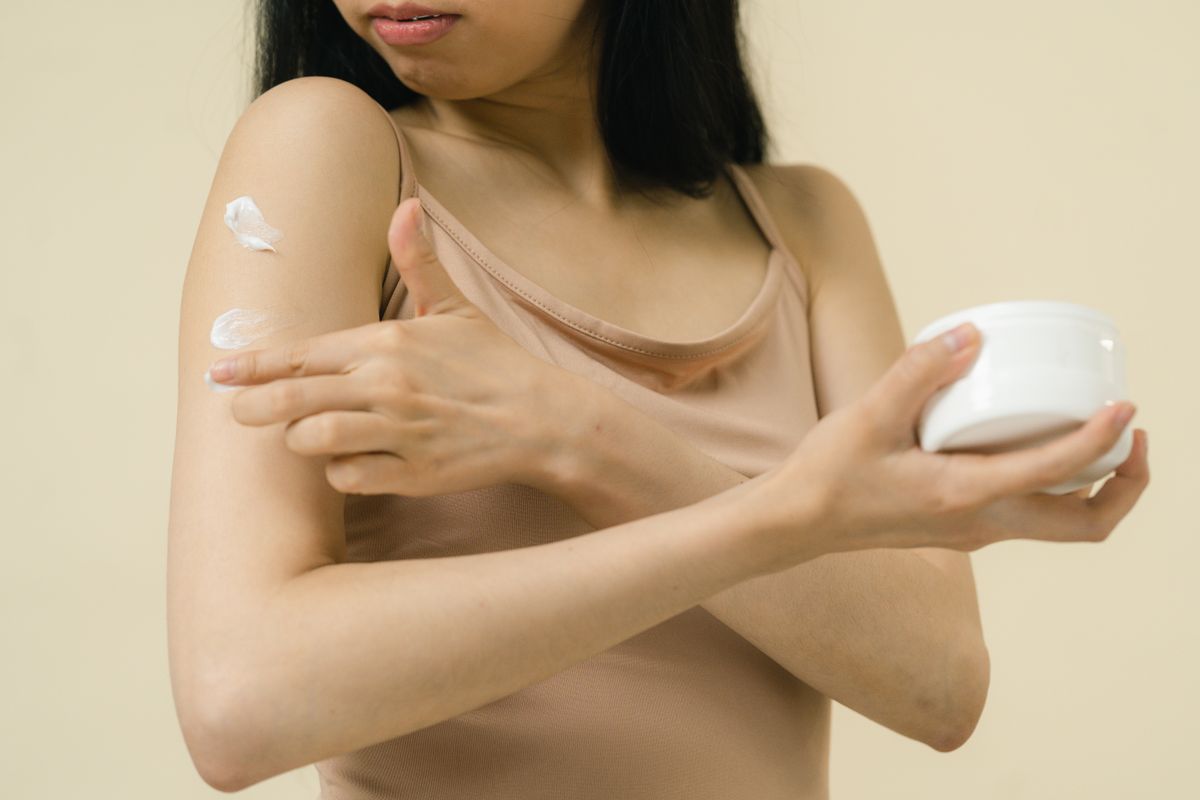
- Apply evenly, in sections: Work one area at a time — legs, torso, arms — using smooth, even strokes. Do not rush the backs of knees, elbows and ankles, where product tends to gather.
- Use enough, but not too much: A thin, even layer is the goal. Thick, gloopy patches are more likely to streak, especially with bronzers.
- Wash your hands afterwards: This prevents stained palms and stops bronzer transferring to places you did not intend.
- Wait a moment before dressing: Give the cream a minute or two to absorb so it does not rub off onto your clothes.
Apply the cream shortly before your session, not hours earlier, so it is still present on the skin when the lamps are on. If you are using a bronzer, wear dark, loose clothing after the session and avoid white bedding until the colour has fully developed and you have showered.
Common Mistakes to Avoid
- Using outdoor sunscreen on a sunbed: Sunscreen blocks UV and defeats the purpose of the session, while also not being designed for indoor equipment.
- Using sunbed cream outdoors: It offers no sun protection, so outdoor use leaves you unprotected in direct sun.
- Skipping moisturiser between sessions: The pre-session cream is only half the routine; daily moisturising between sessions keeps skin in good condition.
- Jumping to tingle creams too soon: Strong products on unprepared skin are a common cause of discomfort and blotchiness.
- Overdoing session length: No cream compensates for too long a session. Follow the salon’s guidance for your skin type and build up gradually.
- Applying over irritated skin: If your skin is sore, peeling or sunburned, skip the session until it has recovered.
Sunbed Safety Notes
It is worth being straightforward here: indoor tanning involves exposure to ultraviolet radiation, which is known to damage skin and increase the risk of skin cancer over time, and no lotion or cream removes that risk. Responsible use means keeping sessions infrequent and short, following the salon’s recommended times for your skin type, always wearing the protective eyewear provided, and never using a sunbed on skin that is burned, broken or irritated.
Certain people should avoid sunbeds altogether, including those with very fair skin that always burns, people with a large number of moles or a personal or family history of skin cancer, and anyone whose medication warns about sun sensitivity. Young people are also at greater risk from UV damage, and tanning salons in the UK are not permitted to allow under-18s to use sunbeds. If you notice a new or changing mole, or any skin change that worries you, see a doctor rather than covering it with a tan.
A tan is often treated as a sign of health, but it is actually the skin’s response to UV damage. If your goal is simply to look bronzed for an occasion, a self-tan product applied at home gives colour without UV exposure at all, and is worth considering as the lower-risk option.
After Your Session: Skin Care
What you do after the session affects how your tan looks over the following days. Drink water, since tanning sessions can be dehydrating, and moisturise daily with a plain, fragrance-free body lotion or a dedicated after-tan moisturiser. Avoid hot showers, harsh scrubs and exfoliating products for a day or two after a session, as these speed up skin shedding and fade colour faster.
If your skin feels tight or looks red after a session, that is a sign the session was too long or too strong for your skin, not a sign that you need a stronger cream. Let your skin settle fully before your next session, and ask salon staff to review your session time. Persistent redness, blistering or peeling should be left alone to heal and, if severe, checked by a healthcare professional.
Frequently Asked Questions
Do I need sunbed cream, or can I use normal moisturiser?
You can use a plain moisturiser, and for a beginner it is a perfectly reasonable starting point. Sunbed creams are simply formulated for the job, with textures and ingredients chosen for indoor tanning, and bronzers or accelerators added in some formulas. The most important thing is that your skin is moisturised, whichever suitable product you use.
Can I use sunbed cream on my face?
Only if the product says it is suitable for facial use. Facial skin is more sensitive, and strong formulas, especially tingle creams, should not be used on the face. Many regular tanners use a gentle facial formula or simply protect the face and let it develop colour more slowly.
How often should I use a sunbed?
Follow your salon’s guidance and keep sessions infrequent, with rest days between them so your skin can recover. More frequent sessions do not produce a proportionally deeper tan — they mainly increase cumulative UV exposure.
Will sunbed cream stop me burning?
No. Sunbed cream is not sun protection and does not prevent burning. Burning is a sign of overexposure, and the only reliable prevention is shorter sessions appropriate to your skin type, with rest days in between.
Is a bronzer the same as fake tan?
Partly. Many bronzers use the same colour-developing ingredient as fake tan, so they give surface colour that develops over a few hours and fades as skin sheds. The difference is that a bronzer is designed to be worn during a tanning session, while a standalone fake tan is designed to be the whole colour on its own.
Conclusion
Sunbed cream is a useful part of an indoor tanning routine when chosen and applied well: a gentle accelerator for beginners, a bronzer when you want instant colour, and richer moisturising formulas for dry skin. The real foundations, though, are unglamorous — hydrated skin, even application, sensible session lengths, protective eyewear, and rest days between sessions. Used that way, your tan will look more even and natural, and your skin will be in better condition for it. And remember, if you simply want colour without UV exposure, a good self-tan remains the safest way to get it.